
NASA's DiskSat Technology Demonstration Launches to Low Earth Orbit
NASA's innovative DiskSat technology demonstration has successfully launched to low Earth orbit, set to validate a flat small spacecraft architecture that could revolutionize CubeSat and small satellite design.
DiskSat features a flat disk design measuring 1 meter in diameter and 2.5 cm thick, offering larger surface area and superior thermal management compared to traditional CubeSats. Equipped with electric propulsion for orbit changes and maintenance, it's suitable for very low Earth orbit (VLEO) operations, providing high-resolution Earth observation and low-latency communications. Four DiskSats will be sequentially deployed from a specialized dispenser to validate this innovative architecture's advantages in reducing costs and expanding scientific opportunities, supporting NASA's Moon-Mars exploration and Earth research goals.
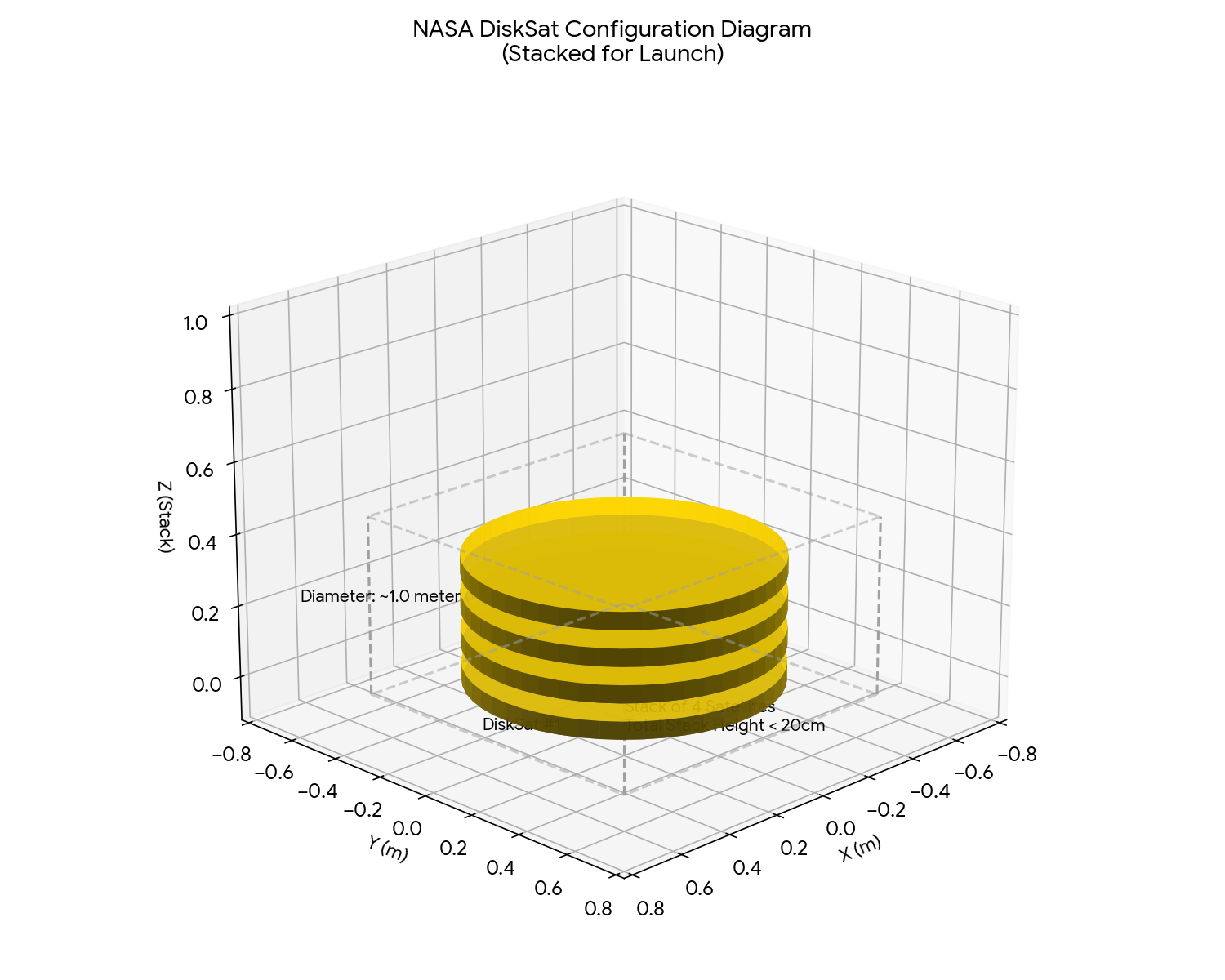
DiskSat features an innovative flat architecture design, only a few centimeters thick
The DiskSat technology demonstration represents a major breakthrough in small spacecraft design, validating a novel flat platform architecture that opens new possibilities for future high-power, high-performance small satellite applications.
DiskSat, along with three other CubeSat projects, launched to low Earth orbit on December 18, 2025, as part of NASA's Small Spacecraft Technology program. Developed by NASA's Ames Research Center in Sunnyvale, California, this project represents a significant innovation in small spacecraft design.
DiskSat features a groundbreaking flat design, only a few centimeters thick. Project lead Marcus Murbach notes that traditional cubic or cylindrical spacecraft designs have dominated for decades, while DiskSat explores the viability of a flat architecture from the ground up.
This design rearranges all internal components into a compact board-like structure similar to computer logic boards, while most of the surface area can be used for solar panels. The flat design not only provides greater solar collection area but also simplifies satellite stacking and transportation processes.
- Higher power-to-weight ratio thanks to expanded solar array surface area
- Compact structure beneficial for stacking during transport and reducing launch costs
- Innovative power and thermal management system architecture
- Highly adaptable mission payload integration approach
The primary goal of this demonstration flight is to validate the basic functionality of the DiskSat platform in the space environment, including key subsystems such as communications, attitude control, power management, and thermal control. The mission team will monitor the platform's performance under extreme temperature variations, radiation environments, and vacuum conditions to establish a foundation for future applications.
If the DiskSat technology demonstration succeeds, it will open up new design approaches for the small spacecraft industry. The flat architecture is particularly suitable for high-power applications such as electric propulsion systems, inter-satellite communications, and Earth observation missions.
Additionally, this design provides more flexible options for mass production and constellation deployment of small spacecraft, potentially significantly reducing the overall cost of small satellite constellations.
The DiskSat project underwent three years of development, overcoming multiple technical challenges including vibration response of the flat structure, heat dissipation path optimization, and component miniaturization. The development team adopted a rapid iteration approach, validating the design's reliability through multiple ground tests and thermal-vacuum experiments.